Catio Tunnel, Standard
from $43.85
View at sellerPrice from habitathaven.com, checked Oct 9, 2026. Prices change.
Catio types
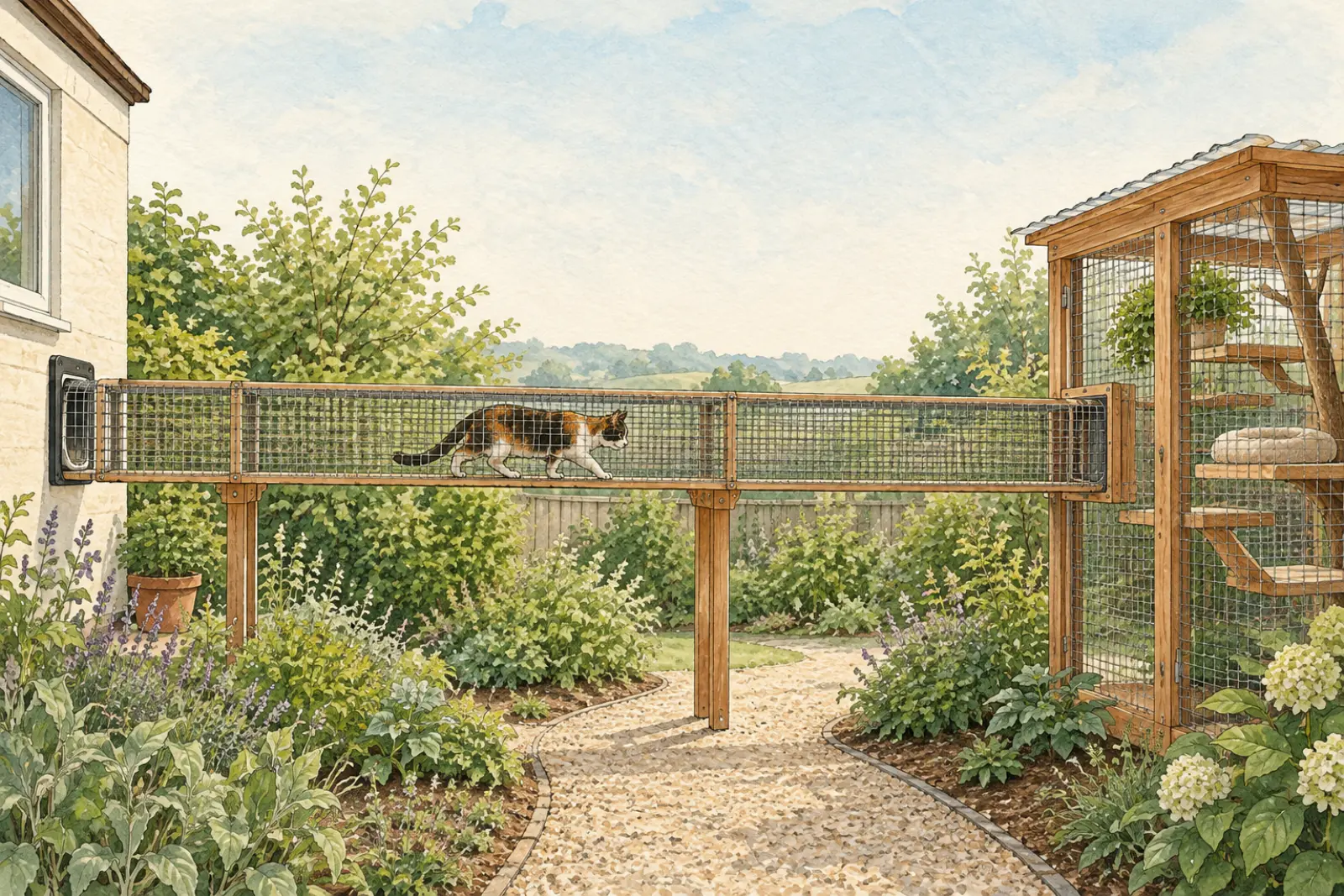
A catio tunnel is an enclosed passage between your window or cat door and an outdoor cat enclosure. You need one when the enclosure sits away from the house or the route needs a turn or a change in height.
Checked: Oct 2026
A tunnel lets you separate the catio’s location from your cat’s entry point. Catio Spaces describes its tunnel as a way to connect your home to a freestanding catio, with access through a cat door installed in a window, wall or slider door.
Start by identifying the entry point and the enclosure opening, then trace the route between them. A straight passage may suit aligned openings; an offset route may need side access or connected sections. Catio Spaces includes L turns and elevation changes in its tunnel designs.
A tunnel is not automatically necessary if your enclosure already meets the home’s access opening. It also is not a substitute for checking how that opening will connect to the passage. If you rent and cannot alter the home, settle the window insert or cat-door arrangement before choosing the tunnel.
Habitat Haven lists tunnels approximately 12 inches wide and 15 inches high, with a cedar floor included. Its stated length range is 18 to 92 inches in 6-inch increments; confirm the available selection for your route. Sections can connect to make a passage longer than 92 inches.
Habitat Haven’s configurations change where your cat enters or exits, rather than making every section a bent passage. The tunnels arrive fully assembled with openings based on your selection. Match those openings to the route before ordering.
Omlet sells a powder-coated steel welded-mesh section and lists its dimensions as 2 ft 12 in x 1 ft 4 in x 1 ft. Prices were checked in October 2026: Omlet lists the section at $99.00, a corner at $65.00 and a stand at $79.00. It also lists a mesh edge protector at $12.00, a tower at $169.00 and a horizontal extension for a window box at $109.00; price the components your route needs, not just the passage.
from $43.85
View at sellerPrice from habitathaven.com, checked Oct 9, 2026. Prices change.
$99
View at sellerPrice from Omlet US, checked Oct 9, 2026. Prices change.
$191
View at sellerPrice from k9-kennelstore.com, checked Oct 9, 2026. Prices change.
Habitat Haven recommends support approximately every 10–12 feet, attached to a structure or a support post. It warns that longer spans can have progressively more flex and sway. Connecting sections for extra length does not remove the need to plan supports.
Omlet says its tunnel can run along the ground, against a wall or fence, or on a stand. Choose the route with its support locations in mind, rather than deciding where to attach it after buying. A raised passage is the wrong choice if you have no suitable way to support it.
At the house end, Cuckoo4Design describes using a window insert with either a built or prefabricated tunnel leading to a premade enclosure. Habitat Haven says its tunnels connect to its stairs, towers, bridges and enclosures, and its standard tunnel can link a building to an enclosure. Check the connection details at both ends rather than assuming different sellers’ components fit together.
For a height change, Habitat Haven describes pairing top-access and bottom-access tunnels so cats can ascend or descend. Check which opening meets the adjoining component before selecting either section. The route needs to work as a connected passage, not merely as separate pieces placed nearby.
Catio Spaces lists its Cat Tunnel plan at $29.95 as a PDF download, with materials sold separately. The listed design is 20 inches high and 18 ½ inches deep, with an 8-foot length plus 1 1/2-inch end panels. The plan also includes custom lengths, configurations and mounting options.
The Catio Spaces design uses natural cedar flooring, wood frame panels, and wire-mesh roofing and sides. Optional polycarbonate roofing can be added for seasonal weather, and the wood panels can remain natural or be painted. Panels are built separately and assembled before installation; a door in the center of the front panel provides outdoor access to your cat.
The plan includes a tool list, material list, instructions and diagrams, with materials available from local home improvement or lumber stores. This option suits a route needing custom dimensions, but not someone looking for a ready-assembled passage. Review the materials and mounting options before committing to the build.
Cuckoo4Design’s separate walkthrough uses pressure-treated 2×4 lumber, deck planks and vinyl-coated wire fencing, with galvanized mesh offered as another option. It describes an 11-inch-wide walking surface with a mesh section 14 inches high. For fence-top sections, the author used lighter cedar fence planks on homemade wooden shelf brackets; the source describes deck planks as cheaper but heavier, so consider weight alongside material cost.
Yes. Catio Spaces describes access through a cat door installed in a window, and Cuckoo4Design describes a window insert connected to a built or prefabricated tunnel. Check how your chosen window connection attaches to the tunnel before ordering.
Habitat Haven lists individual lengths from 18 to 92 inches and says sections can connect for longer runs. It recommends supports approximately every 10–12 feet and warns that longer spans can flex and sway more.
Yes. Omlet lists a corner component, while Catio Spaces includes connected tunnels with L turns in its DIY plan. Habitat Haven offers left- and right-side access configurations, so check the opening layout rather than assuming the tunnel itself bends.
Yes. Catio Spaces sells a PDF plan with tool and material lists, instructions and diagrams, but materials are not included. Its design includes cedar flooring, wood frame panels, wire-mesh sides and roofing, and custom sizing options.
Facts, prices and rules on this page come from these pages, read on October 9, 2026. Sellers change prices and plans often; check the source before you buy.