Checked: Oct 2026
Choose a plan and prepare your site
Pick a design before buying materials, then measure your available space against the plan. Catio Spaces offers different designs and sizes, with flexibility to adapt them to your preferences or budget. Check the layout and access door as well as the overall footprint.
Plan for a flat, level base. Catio Spaces advises leveling garden or grassy sites before building and completing deck or patio repairs beforehand. It also notes that size and location may affect permit or homeowners’ association requirements, so check with your city or association about height and setbacks.
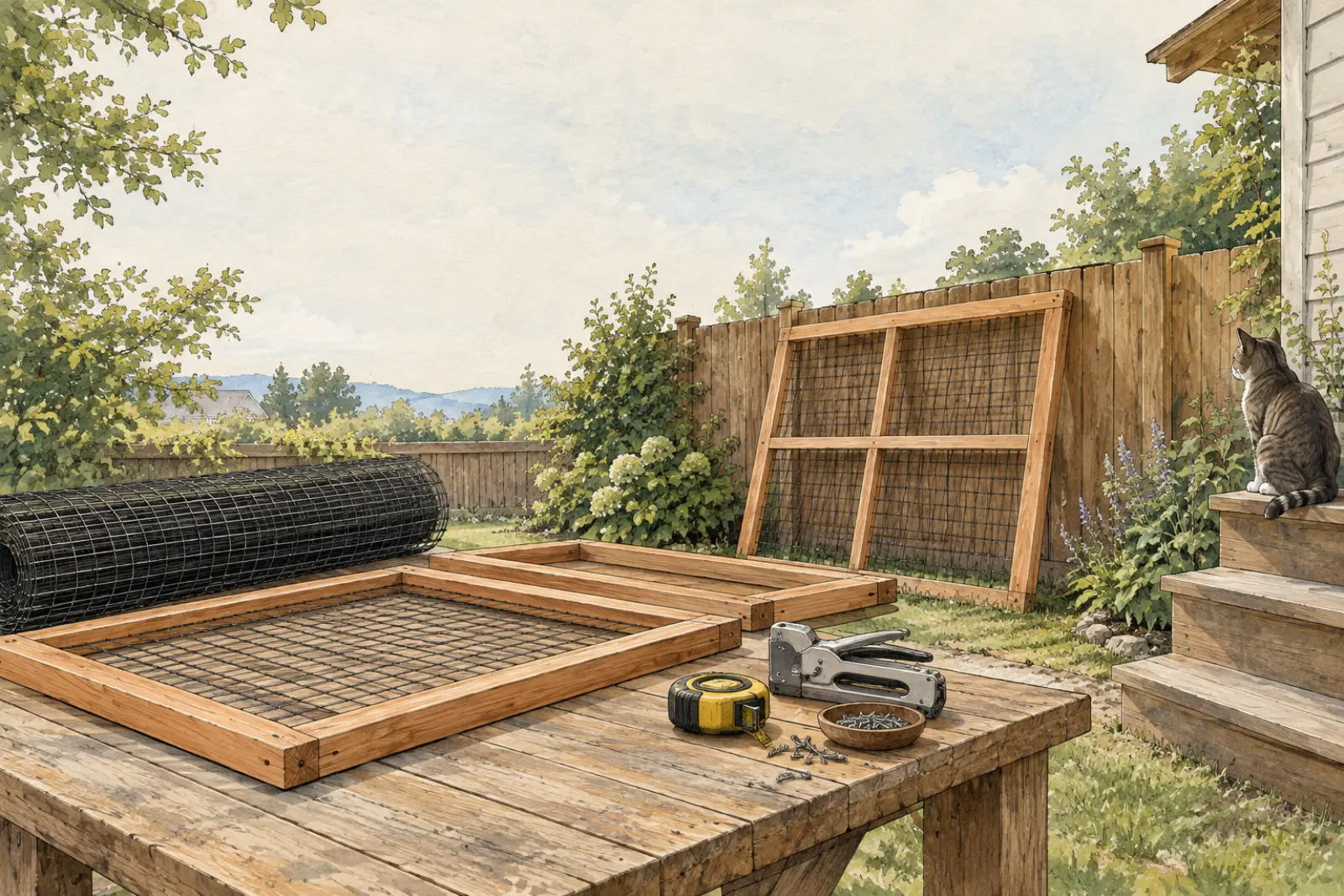
For enclosure mesh, Catio Spaces recommends galvanized 16-gauge fencing wire with 2-inch by 3-inch openings. Smaller openings are available, but account for the extra cutting involved. Its guidance advises against chicken wire, which can bend and leave jagged cut edges, and window-screen mesh, which cannot withstand a cat’s claws.
Choose lumber using the plan’s materials list rather than guessing at board sizes or quantities. Catio Spaces lists wood, wire, roofing, hardware, screws, and paint or stain among the construction materials. You can paint or stain the wood to complement your home, but arrange material pickup or delivery before scheduling the build.
- Compare the plan’s dimensions with your measured space.
- Check the base and finish any needed repairs.
- Use the materials list to organize lumber, mesh, roofing, and hardware.
Match the build to your skills
Catio Spaces says a DIY catio requires basic carpentry skills and the ability to follow instructions. Its plans include diagrams, instructions, and tool and materials lists. Use the chosen plan’s tool list to check what you need before buying supplies; the supplied facts do not establish a universal tool kit for every design.
For wire work, Catio Spaces describes rolling out, measuring, cutting, and stapling fencing wire to a wood frame. It says 16-gauge wire can be cut with flush-cut pliers. Cut flush to the welded grid line and cover sharp ends with wood trim so they cannot catch your cat’s paws or skin.
Paid plans suit you if you want documented instructions rather than designing the structure yourself. Catio Spaces lists PDF plans at $39.95–$69.95, with prices checked in October 2026. The Catio Company’s downloadable plans include cut lists and tool lists, but no building materials, so a plan purchase is not a kit.
Consider a kit instead if sourcing lumber, mesh, and hardware separately does not suit you; check its listing for included parts and assembly requirements. If basic carpentry is outside your comfort level, a self-directed build may be the wrong choice. Catio Spaces notes that giving a ready-made plan to a carpenter can make accurate quotes easier to obtain.
Three free plan outlines
Each outline has a blueprint, a step list and a materials estimate on the catio plans page.
Sources
Facts, prices and rules on this page come from these pages, read on October 9, 2026. Sellers change prices and plans often; check the source before you buy.
- Catio Spaces: Is It Cheaper to Buy or Build a Catio? (catiospaces.com)
- The Catio Company — DIY Catio Plans (thecatiocompany.com)
- Catio Spaces (catiospaces.com)
- 8 Catio Building Mistakes to Avoid — Catio Spaces (catiospaces.com)