Checked: Oct 2026
Welded wire: gauge, openings, and coatings
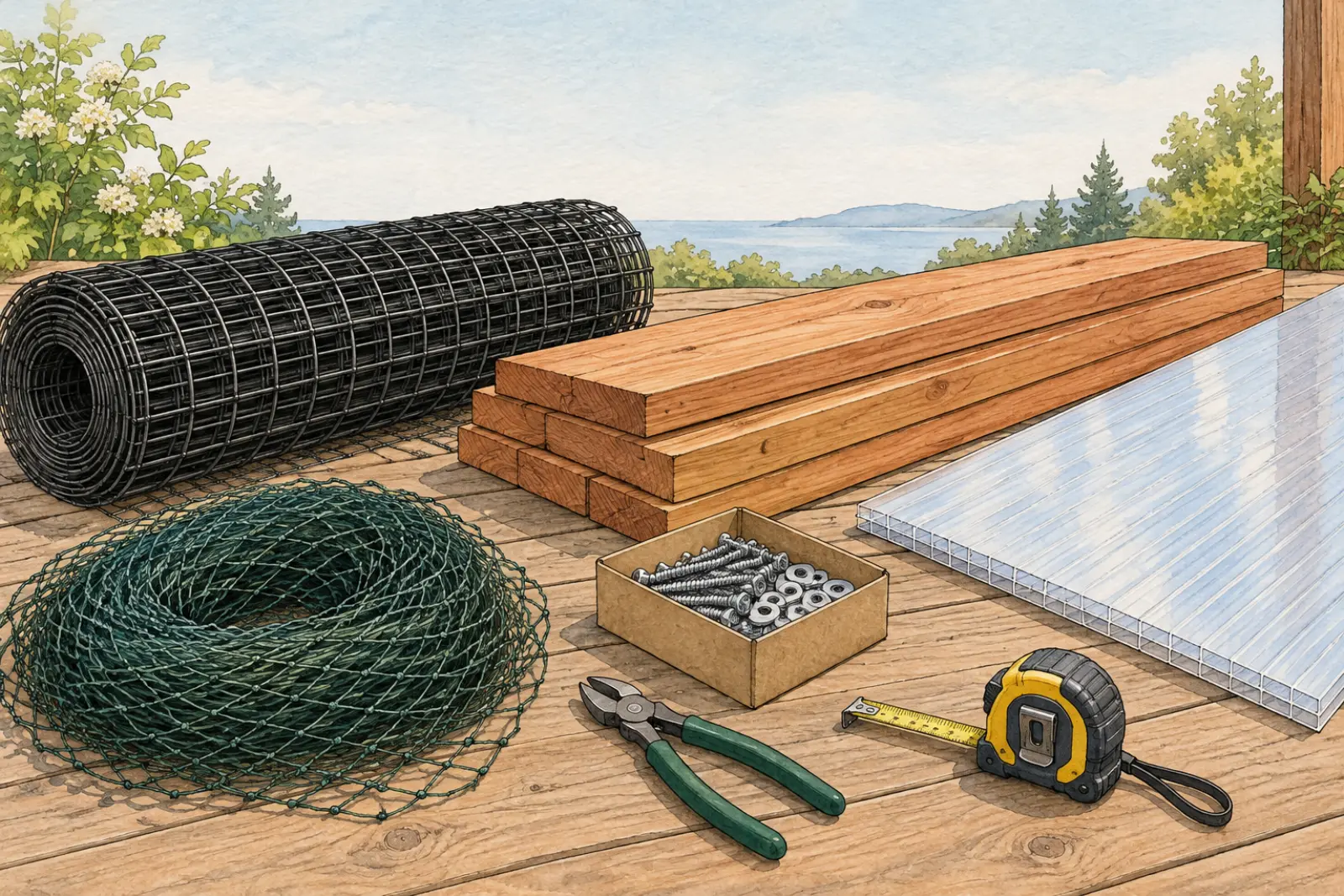
Catio Spaces recommends 16-gauge galvanized fencing wire with 2″ x 3″ openings, available at most home improvement stores. Lower gauge numbers mean stronger wire, but opening size is a separate decision. Catio Man says 2″ x 3″ mesh is intended for adult cats and will not contain a small kitten; it also acknowledges that paws or legs could get caught.
For smaller cats, compare smaller openings rather than choosing by gauge alone. Catio Man describes 1″ x 1″ wire mesh as suitable for containing kittens, though it obstructs the view more. Catio Spaces advises allowing for the additional cutting required with smaller grids.
Sources disagree about coatings. Catio Spaces recommends galvanized wire for rust protection and advises against vinyl coating because it can split, deteriorate, and be chewed. The Catio Company recommends galvanized steel or PVC-coated mesh, while Easy Pet Fence describes its coated catio mesh as chew-resistant. If your cat chews enclosure materials, do not treat the coating as an automatic upgrade.
Compare the steel core gauge, opening size, roll height, and roll length separately. Easy Pet Fence lists a 4′ x 100′ roll with a 14-gauge galvanized steel core, black PVC coating, and approximately 2″ x 2″ openings for $259.95; prices were checked in October 2026. Its approximately 12-gauge finished thickness includes the coating, so that figure is not the steel core gauge.
- Easy Pet Fence also lists 3′ x 100′ mesh with 2″ x 2″ openings.
- Its 2′ x 100′ option has 1.5″ x 1.5″ openings.
- Its 4′ x 50′ option has 1″ x 1″ openings.
- Those alternatives use 14-gauge black PVC-coated steel; check their listings for current prices.
Netting, chicken wire, and insect screen
If you are considering catio netting, first establish what the product is intended to contain. The sources here do not establish a suitable netting specification or use case. The Catio Company warns that plastic mesh can weaken outdoors and that cats may chew through or scratch it, so flexible mesh should not be assumed equivalent to welded wire.
Chicken wire is a poor choice for the main enclosure barrier. Catio Spaces says it is not very strong, may rust, and can leave jagged edges when cut. It identifies chicken wire as typically 19–22 gauge, compared with its recommended 16-gauge fencing wire.
Ordinary insect screen is not a substitute for containment wire. Catio Spaces says window-screen mesh cannot withstand cats’ claws and that persistent cats and wildlife can get through porch screening. Catio Man notes that some owners add screen to exclude bugs; Cattopia describes pet-grade vinyl-coated polyester screen as stronger than traditional fiberglass, but that does not establish it as a replacement for welded wire.
What builders and sellers say about mesh and roofs
| What the source says | Source |
|---|---|
| The page recommends 16-gauge fencing wire with 2″ x 3″ grid openings for DIY catios. |  Catio Spaces Catio Spaces |
| Chicken wire is typically 19-22 gauge. | Catio Spaces |
| The page advises avoiding vinyl-coated wire because it breaks down and splits over time, and cats may chew it. | Catio Spaces |
| One listed option is 14-gauge black vinyl-coated welded wire mesh with 1-inch by 1-inch openings. |  The Catio Company The Catio Company |
| Another listed option is 14-gauge galvanized steel welded wire with black PVC coating and 2-inch by 2-inch openings. | The Catio Company |
| The guide recommends 16- to 19-gauge wire to balance strength and visibility. |  Cat Topia Cat Topia |
| The guide recommends 1-inch x 1-inch grid spacing to keep out rodents and prevent cats from squeezing paws through openings. | Cat Topia |
| The welded wire catio mesh has a 14 gauge galvanized steel core with a black PVC coating. | Easy Pet Fence |
| The mesh roll measures 4 feet high by 100 feet long. | Easy Pet Fence |
| Polycarbonate roofing is described as lightweight, virtually unbreakable, and resistant to weather and sunlight. | The Catio Company |
| Corrugated metal roofing can last over 20 years with proper maintenance. | The Catio Company |
As published by each builder or seller, read Oct 9, 2026. Catio Spaces notes that a lower gauge number means stronger wire.
Frames and mesh fasteners
Cattopia describes cedar and redwood as outdoor choices whose natural oils deter pests and resist rot. Its framing guide recommends 2×4 lumber for walls, platforms, and roof supports, with 4×4 corner posts worth considering for freestanding or multi-level builds. It recommends 2×6 or larger roof joists for heavier roofing such as corrugated metal or polycarbonate.
Pressure-treated lumber appears in Cattopia’s guidance for decking, where it provides strength, elevation, and drainage. That is not a complete pressure-treated frame specification. Likewise, the supplied sources do not give metal-frame member sizes or connection details, so a metal catio needs its own assembly instructions rather than borrowed wood-frame fastening advice.
For wood frames, Catio Spaces describes rolling out, measuring, cutting, and stapling the wire. Cut with flush-cut pliers at the welded grid line to avoid exposed sharp ends. The Catio Company advises leaving extra mesh for full coverage, fastening it tightly, and inspecting the finished enclosure for gaps or loose areas.
- The Catio Company lists fence staples as an alternative mesh fastener.
- It recommends 1×2 wooden strips over mesh edges where they meet the frame.
- Check cut edges for anything that could catch paws or skin.
Roofing for weather protection
Keep overhead enclosure coverage separate from weather protection when comparing roof materials. A mesh-only roof does not provide the solid shelter described in the roofing sources. The Catio Company recommends corrugated metal, polycarbonate, or asphalt shingles for protection from the elements.
Polycarbonate lets light through while providing weather protection, according to Cattopia. The Catio Company lists corrugated and flat multiwall designs with UV protection and impact resistance. Cattopia says tinted or frosted panels reduce glare and heat buildup, but also warns that panels can scratch during handling and need a suitable cleaning solution.
Metal roofing blocks sunlight and can amplify rain or hail sounds, which may bother some cats. Cattopia suggests roofing felt, plywood sheathing, or insulation beneath metal panels to reduce noise and heat transfer. It also recommends a sloped roof to direct rain and snow runoff rather than allowing water to accumulate.
Lightweight corrugated plastic and PVC roofing are easier to handle, but Cattopia warns that they can crack under heavy impacts and discolor with prolonged UV exposure. Its guide describes tarps as temporary weather protection that can shift in wind if poorly secured and require replacement. For an awning, check the product’s weather limits and attachment instructions; the supplied sources do not specify an awning system.
Floors and a digging-resistant base
For a ground-level catio, Cattopia describes concrete and paver stones as flat, durable surfaces resistant to moisture, pests, and digging. These are the supported choices here if preventing digging is a priority. The sources do not provide a buried-wire depth or perimeter detail for a soil-floor enclosure.
For an elevated floor, Cattopia recommends pressure-treated wood decking for strength and drainage. Sand surfaces to remove splinters and sharp edges. Its guide also recommends a pet-safe exterior wood sealant to preserve the decking and reduce absorption of urine or spills.
Turf, grass, and gravel need attention to the layers beneath them, not just the visible surface. Cattopia recommends landscaping fabric and gravel beneath turf or grass for drainage, and pea gravel or smooth river stones to avoid sharp edges. Those drainage recommendations do not establish a digging barrier, so resolve that separately before choosing a soft ground surface.
Questions people ask
What gauge wire should you use for a catio?
Catio Spaces recommends 16-gauge galvanized fencing wire. Gauge alone is not enough: choose openings appropriate to your cat, since Catio Man says 2″ x 3″ mesh will not contain a small kitten.
Can you use chicken wire for a catio?
Catio Spaces advises against chicken wire because it is weak, may rust, and can leave jagged cut edges. Its recommended alternative is galvanized fencing wire.
Can insect screen keep cats inside a catio?
Ordinary window or porch screen should not be your containment barrier. Catio Spaces says cats’ claws can defeat window-screen mesh and persistent cats or wildlife can get through porch screening.
What can you put on a catio roof?
The Catio Company recommends corrugated metal, polycarbonate, and asphalt shingles. Polycarbonate allows light through, while metal blocks sunlight and can be noisy in rain or hail.
Sources (7)
Facts, prices and rules on this page come from these documents, read in October 2026. Sellers change prices and plans often; check the seller's page before you buy.
- Catio Spaces: DIY Catio Materials: How to Pick the Right Cat Enclosure Mesh for Your Catio · checked Oct 2026
- The Catio Company: Wire Mesh for a Catio · checked Oct 2026
- Catio Man: What's the Right Fencing? A Catio Controversy · checked Oct 2026
- Cat Topia: Best Materials for Building a Safe, Long-Lasting Catio · checked Oct 2026
- Cat Topia: What Is the Best Roofing for a Catio? · checked Oct 2026
- The Catio Company: Roof for Catios · checked Oct 2026
- Easy Pet Fence: 4′ x 100′ Catio Mesh 2″ x 2″ Opening · 14 Gauge Steel Black PVC Coated · checked Oct 2026