Checked: Oct 2026
Shelves, perches, and climbing routes
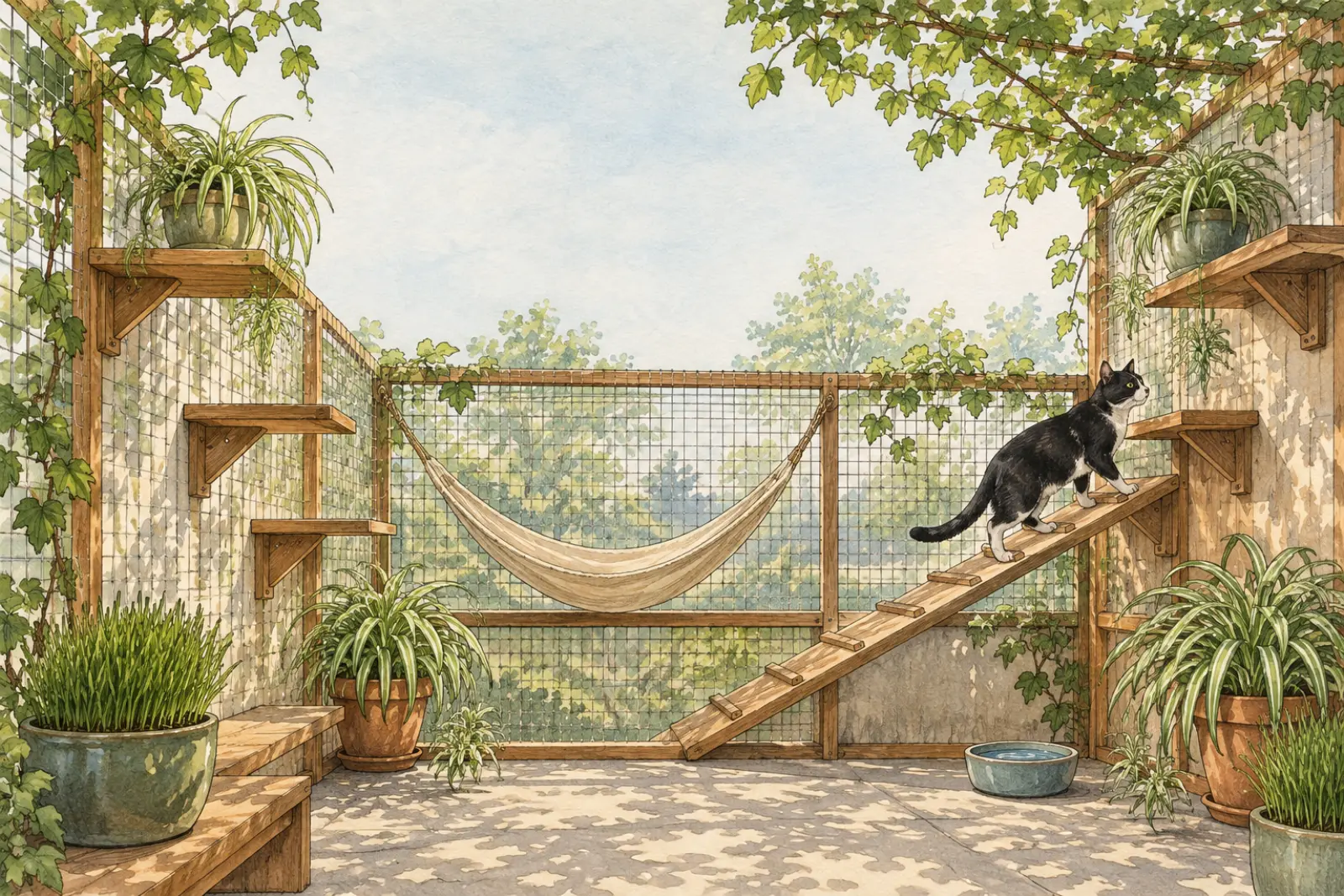
Use shelves to make the enclosure useful above floor level. Catio Spaces describes Finn’s catio with spacious corner shelves for napping, plus a cat tree and toys. That gives you a practical starting point: combine a resting perch with something to climb rather than filling the floor with decorations.
Shelves can also shape the appearance of your catio. In Tracey’s design, Catio Spaces describes deep green shelves and branches alongside natural wood framing. Borrow the color idea if you want the interior to relate to nearby greenery, but choose the layout around your available space.
If ramps or bridges are part of your sketch, check their placement and support requirements in the plan before committing. The examples here describe shelves, branches, and cat trees, but do not supply ramp slopes, bridge spans, or fastening details. A decorative photograph is inspiration, not a construction specification.
Greenery matched to light and space
The Cattopia describes plants as sources of new scents, play opportunities, and shade. Before buying, it recommends verifying each choice with a nursery specialist using the exact scientific name. Do not assume that every plant sold under a similar common name is suitable for your cat.
Match greenery to the light your enclosure actually receives. The Cattopia suggests spider plants for shaded corners and notes that direct sunlight can scorch their leaves. It also describes Boston ferns as suited to shade and humid conditions, so they are not a choice to make on appearance alone.
For hanging plants, The Cattopia recommends plastic pots and suggests baskets or macrame hangers to keep cats from devouring spider plants. On a balcony, Indoor Cat Expert recommends low, stable planters and warns against using foliage to conceal unsafe railing gaps. Plants add enrichment; they do not replace an enclosure.
- For hanging greenery, The Cattopia suggests Swedish ivy.
- For sunny spots, it suggests sunflowers inside or outside the enclosure and marigolds around it.
- For an accessible herb garden, it lists rosemary, sage, and thyme.
- If your cat constantly eats plants, it suggests toys, cat trees, and outdoor furniture instead.
Shade, resting spots, and shared seating
Plan shade before arranging beds or seating. Indoor Cat Expert warns that small enclosures can warm quickly, especially in direct sun or on balconies with glass panels. It recommends shade, airflow, water access, and short sessions, with no catio use during extreme heat or disruptive weather and noise.
Give your cat a choice between an open resting spot and a tucked-away nook. Catio Spaces describes beds and nooks in Ginger’s secret-garden catio, while Finn’s enclosure includes carpeted shelves and hiding spaces in a cat tree. Those examples offer different resting options without requiring a heavily themed interior.
Seating for you can be inside the enclosure or beside it. Catio Spaces describes a chair inside Finn’s catio, nearby deck furniture at Michelle’s white-painted enclosure, and a shared hanging chair in Carolyn’s design. If you are considering a hammock, check its support requirements; the supplied example is a hanging chair, not a cat hammock.
Ideas for windows, balconies, and side yards
A window box is an option when you want an enclosed perch rather than a walk-in space. Indoor Cat Expert describes it as a small enclosure at a window with fresh air and outdoor views. It warns that a normal insect screen cannot support a window catio or withstand repeated pawing.
For a removable setup, Indoor Cat Expert describes portable pop-up catios as mesh tents or foldable enclosures for balconies, patios, or indoor floors near open windows. It suggests introducing the enclosure indoors with familiar bedding, treats, and short sessions. This may suit a renter avoiding a permanent build, but a portable enclosure is not the same as enclosing the whole balcony.
For balcony ideas, separate the enclosure from its accessories. Indoor Cat Expert says clear acrylic railing guards block gaps but are not a complete catio, and netting needs secured edges and frequent checks. Keep chairs, storage bins, planters, and stools away from the edge so they cannot become steps.
Tension-pole frames offer a no-drill approach, according to Indoor Cat Expert, but pressure-mounted parts need checking before every session. For a narrow side yard, first measure the usable area and identify what access must stay clear. Tracey’s landscape-adjusted design offers inspiration for working around existing planting, not dimensions you can transfer to another site.
Real designs to borrow ideas from
Catio Spaces describes Ginger’s secret-garden catio as a combination of beds, foliage, shelves, nooks, and decor. The useful idea is layering different activities rather than relying on a single centerpiece. If your space is limited, choose the elements that leave room for your cat to move and for you to reach inside.
Tracey’s design shows how an enclosure can respond to the house and landscape. Catio Spaces describes natural wood framing beside a brick home, with deep green shelves and branches. It also reports that Tracey adjusted the DIY plan outside a bedroom window to preserve existing trees or bushes.
For window-based inspiration, Catio Spaces describes Nancy’s Haven catio over a large deck window and apartment resident Jenn’s Window Box catio for neighborhood views and sunbathing. For shared outdoor space, it describes Carolyn’s deck enclosure with napping shelves and a hanging chair. Borrow the arrangement that matches your space; these descriptions do not establish that the same design will fit your window or deck.
Questions people ask
What can you put inside a catio?
Catio Spaces’ examples include shelves, beds, hiding nooks, cat trees, toys, and seating for people. Plants can add scents and shade, but verify the exact plant identity before choosing greenery your cat can access.
Which plants can you put in a catio?
The Cattopia suggests spider plants, Boston ferns, Swedish ivy, sunflowers, marigolds, and herbs including rosemary, sage, and thyme. Verify choices by scientific name with a nursery specialist; the source also warns that even non-toxic plants can cause vomiting.
Can you make a catio without drilling?
Indoor Cat Expert describes portable pop-up enclosures and tension-pole frames as options that avoid a drilled installation. Pressure-mounted frames still need checking before every session because environmental changes and movement can loosen them.
Sources
Facts, prices and rules on this page come from these pages, read on October 9, 2026. Sellers change prices and plans often; check the source before you buy.
- Catio Spaces (catiospaces.com)
- Cat Topia — Non-toxic Plants for Cats (thecattopia.com)
- Indoor Cat Expert (indoorcatexpert.com)