Town & Country
$298.95
View at sellerPrice from mythreecats.com, checked Oct 9, 2026. Prices change.
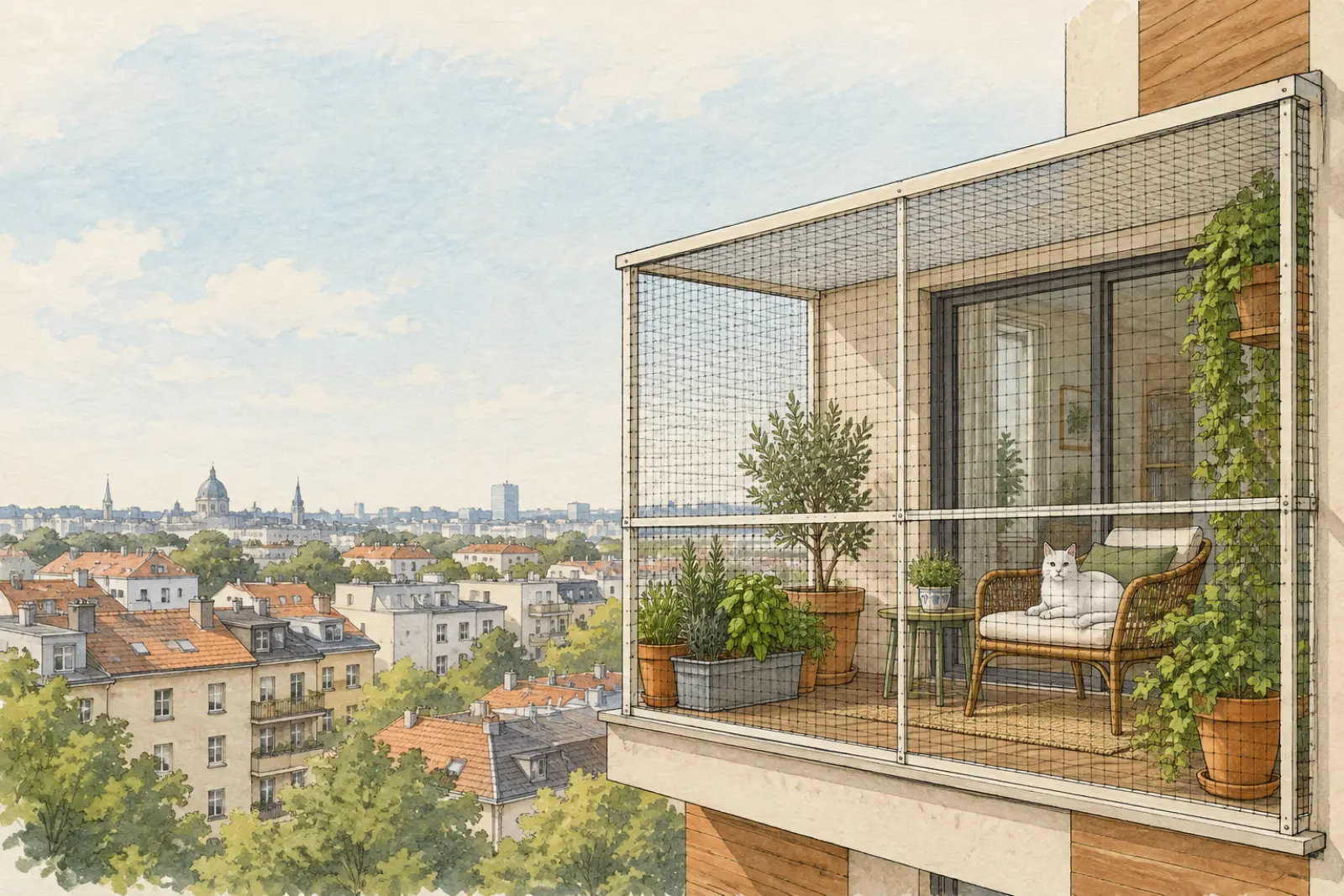
Catio types
A balcony catio needs a fully closed boundary, secure attachments, and an approved layout that preserves access and drainage. Netting, mesh panels, and freestanding enclosures can work in different spaces, but no-drill mounting alone does not make a balcony safe for your cat.
Checked: Oct 2026
Start by measuring the clear usable balcony footprint and the indoor access route, as Meowant recommends. Compare enclosing the whole balcony with placing a separate enclosure inside it; a freestanding frame suits an approved temporary layout with enough clear floor space and no need for exterior attachment.
Netting is a lightweight option when your property permits it and the entire boundary can be closed and inspected. Meowant rules it out when edges, seams, upper routes, or attachment points cannot be secured and maintained. It is not a suitable shortcut for a balcony with openings you cannot reach or inspect.
Mesh or modular panels provide another way to form the boundary, but the connections still matter. Meowant calls for compatible documentation and regular inspection of joints, corners, railing interfaces, and access doors. An existing screened balcony is only part of the plan, not proof that the space is cat-safe.
$298.95
View at sellerPrice from mythreecats.com, checked Oct 9, 2026. Prices change.
$129.99
View at sellerPrice from pawhutstore.com, checked Oct 9, 2026. Prices change.
$199.99
View at sellerPrice from aivituvin.com, checked Oct 9, 2026. Prices change.
$329.99
View at sellerPrice from pawhutstore.com, checked Oct 9, 2026. Prices change.
Balconycat.com defines true no-drill installation as leaving no holes in walls, floors, ceilings, or other fixed surfaces, and no permanent marks after removal. It says many nets marketed as no-drill use adhesive hooks or sticky pads. Removing those attachments can damage textured render, painted brick, or older plaster.
Tension-pole frames use vertical pressure-mounted poles to support mesh or panels without drilling, according to Indoor Cat Expert. Balconycat.com warns that a cat pushing against an enclosure, frame settling, or vibration can overcome the friction holding tension systems in place. It also notes that approximate sizing can leave gaps around balcony openings.
Indoor Cat Expert advises checking pressure-mounted frames before every session because temperature changes, humidity, vibration, and movement can loosen them. Balconycat.com also warns that adhesive attachment points are not structurally rated for cat weight plus dynamic load. If attachment strength is uncertain, Meowant recommends property-specific or qualified review rather than relying on general pet guidance.
Review your lease and building rules before choosing an enclosure. Meowant recommends obtaining written approval from the landlord, property manager, HOA, or building authority, as applicable. Request a written response before buying a setup that is visible outside, attaches to a railing or wall, changes the balcony, or affects access.
Show the proposed footprint, attachment method, and route between the apartment and enclosure. Ask how the plan fits restrictions on drilling, shared exterior appearance, drainage, and emergency access. Indoor Cat Expert identifies lease rules, balcony height, fire exits, and window limits as apartment-catio planning constraints.
Do not treat removable as automatically permitted. Meowant says a renter's setup must be permitted, stable, fully closed, inspectable, and clear of drainage and egress conflicts. Remove it and restore the balcony when approval ends or the installation no longer matches the approved plan.
Secure every cat-accessible opening rather than expecting your cat to recognize the fall risk. Meowant recommends inspecting railing interfaces, seams, corners, upper edges, screen edges, and door areas for escape routes. No balcony setup is automatically escape-proof or universally safe.
Indoor Cat Expert says cats can chew, climb, push, or test weak edges in netting. Keep netting tight and secured at its edges; a loose bottom edge can let a cat push underneath. The enclosure must account for rail gaps, furniture launch points, and the door route back indoors, not just the area above the handrail.
Acrylic railing guards block railing gaps but are not complete catios, according to Indoor Cat Expert. They do not stop a cat from jumping over the top when furniture is nearby, and ordinary insect screens are not designed to support a cat's weight or withstand repeated pawing. For a high-rise apartment, the guide recommends a fully secured enclosure or an indoor alternative.
Provide shade, airflow, fresh water, and a dry retreat, as Meowant recommends. Indoor Cat Expert warns that small enclosures can warm quickly, especially with glass panels or direct sun. Use short sessions and bring your cat indoors when conditions become unsuitable; avoid use during extreme heat, storms, or high wind.
Plan perch or shelf placement around the enclosure boundary, not just the view. Indoor Cat Expert warns that furniture can become a step toward the railing, so do not create a launch point toward an opening or upper edge. The supplied guidance does not establish shelf load ratings or mounting specifications; seek qualified review where support is uncertain.
Keep planters away from the balcony edge, and check plant safety separately rather than assuming an enclosure resolves unsafe-plant hazards. Introduce your cat gradually and supervise early use while observing both behavior and enclosure condition, as Meowant advises. For a portable mesh tent or foldable enclosure, Indoor Cat Expert recommends supervision and says permanent outdoor placement requires a product designed for weather exposure and safe anchoring.
Possible options include freestanding enclosures and pressure-mounted frames, but Meowant says no-drill does not automatically mean approved, stable, or suitable. The completed setup still needs a fully closed boundary, secure support, and no drainage or emergency-access conflicts.
It can form part of an enclosure when every side and edge can be secured and inspected. Indoor Cat Expert warns that cats can chew, climb, or push at netting, and a loose bottom edge can allow escape.
Check your lease and building rules rather than assuming a removable enclosure is exempt. Meowant recommends written approval from the relevant property authority before buying a setup that affects the balcony, exterior appearance, attachments, or access.
Do not assume enclosure means unrestricted access is safe; Meowant recommends supervised early use and monitoring the cat and conditions. Indoor Cat Expert specifically says pop-up catios should be supervised, and a harness is not a fall-prevention system.
Facts, prices and rules on this page come from these pages, read on October 9, 2026. Sellers change prices and plans often; check the source before you buy.