Checked: Oct 2026
Check plants before your cat enters
Use the ASPCA plant checker on this page to identify plants inside the catio and nearby plants your cat could reach. Match the scientific name when possible rather than relying only on a familiar common name. The ASPCA lists azalea, English ivy, aloe, hydrangea, foxglove, oleander and sago palm as toxic to cats.
Give lilies particular attention. The ASPCA lists Easter lily and tiger lily as toxic, and warns that lilies from Lilium or Hemerocallis species can be lethal to cats. Even small exposures to their pollen can cause kidney failure or death.
Sago palm is another plant to keep away from your cat: the ASPCA says all parts are toxic, with the seeds most concentrated and dangerous. Tulips and their bulbs are also toxic, and ingesting oleander can cause potentially life-threatening heart problems. Do not assume a plant is suitable because it is commonly grown in a yard.
The ASPCA lists the plants below as non-toxic, but also says any plant can cause mild stomach upset when eaten. If your cat eats an unidentified plant or you suspect exposure to a toxic plant, contact your veterinarian or the ASPCA Animal Poison Control Center immediately at (888) 426-4435. Use that contact rather than trying to judge the risk yourself.
- Non-toxic flowers: roses, sunflowers and zinnia.
- Non-toxic foliage plants: spider plant and Boston fern.
- Other non-toxic choices: petunia and African violet.
Check a plant before it goes in
Type a plant name. Results come from the ASPCA toxic and non-toxic plant list for cats (read Oct 9, 2026), with a link to the ASPCA entry.
If your cat ate a plant, call your vet or the ASPCA Animal Poison Control Center. A plant missing from the list is not proof that it is safe.
Choose strong wire and suitable openings
Catio Spaces recommends galvanized welded fencing wire in a 14–16-gauge thickness. Its recommended maximum grid is 2 inches wide by 4 inches high. Treat wire strength and opening size as separate checks: a panel needs both suitable openings and resistance to bending.
Catio Spaces also identifies galvanized hardware cloth with a 1/2-inch by 1/2-inch grid as an option, while noting that it costs more and limits your cat’s view. Compare those tradeoffs before choosing the enclosure material. A smaller grid does not remove the need to inspect how the wire meets the frame.
Chicken wire is a weak choice for a lasting enclosure because, according to Catio Spaces, it bends and stretches easily. The source also warns that a bear can dent or tear taut chicken wire. It is not a suitable shortcut if you are counting on the enclosure to resist wildlife.
- Cover sharp wire ends with wood trim, as Catio Spaces recommends.
- Inspect vinyl-coated wire for deterioration and cracking from UV exposure; Catio Spaces identifies this as a choking hazard.
- Check wire edges and frame connections along the whole enclosure, not just the front.
Inspect doors, gaps, ground and roof
Follow Catio Spaces’ recommendation to inspect from ground to ceiling. Include the door opening, its closure, corners, roof edges and every place the enclosure meets your home. Do not treat a closed door as proof that the rest of the catio is secure.
Ground conditions can change after installation. Catio Spaces warns that growing tree roots and frost-heaved stones can lift part of a catio, create gaps and stress structural joints. Recheck the base over the seasons rather than relying on the fit you saw when it was installed.
For a ground-level catio, inspect below the frame as well as beside it. Catio Spaces says coyotes and other wildlife can dig underneath, creating a route for animals to enter or cats to escape. It identifies a deck or concrete patio as a dig-proof foundation, but that does not replace checks of doors, walls and the roof.
- For soil foundations, Catio Spaces suggests wire outside the ground frame at a 90-degree angle, attached to the frame and buried beneath soil or sod.
- Concrete pavers around the perimeter or inside the catio are another suggested dig-proof option.
- Plan access carefully: Catio Spaces warns that carrying your cat to and from the catio adds an escape risk.
Provide shade, water and weather checks
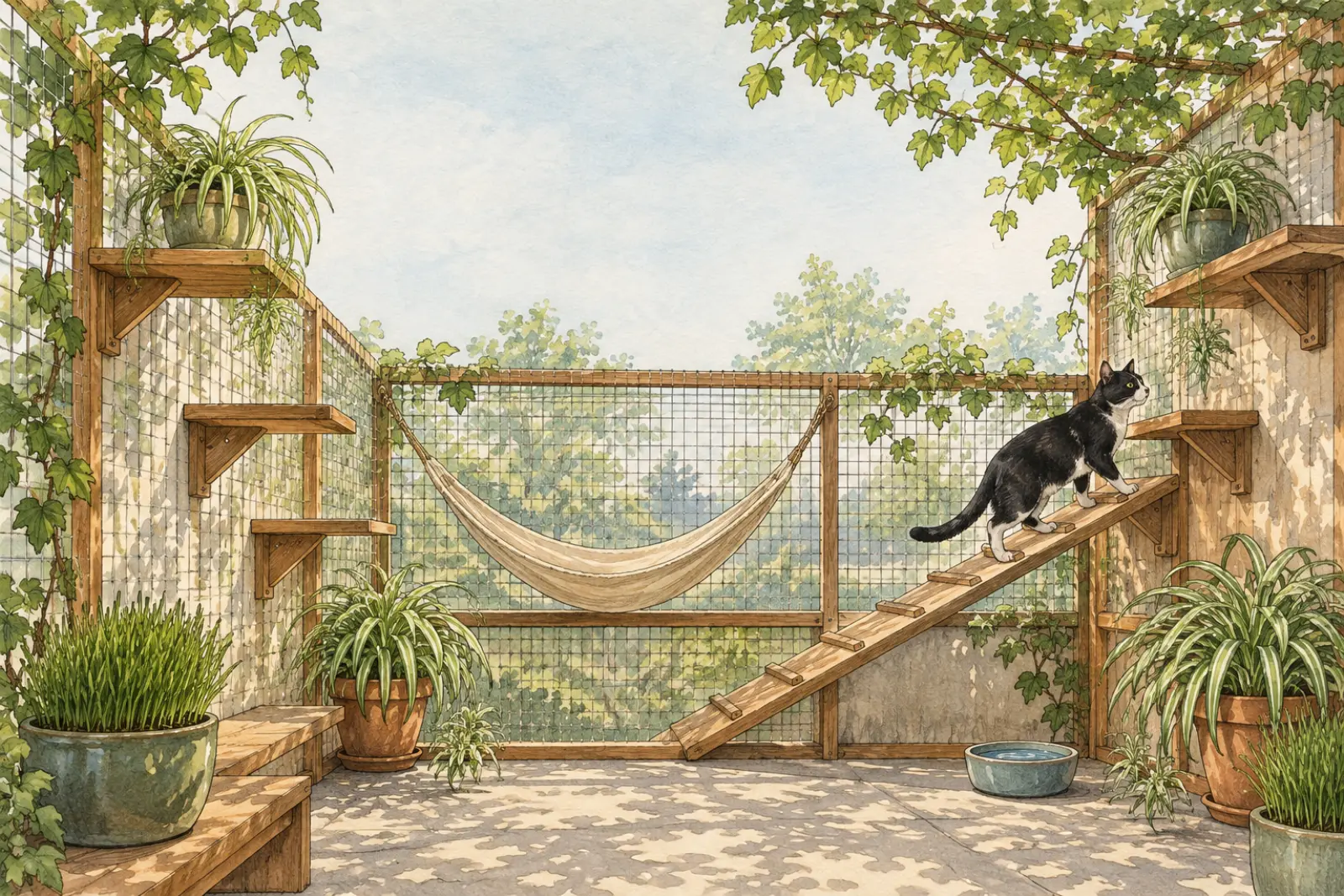
Your cat needs a choice of shady spots, especially during hot weather. Catio Spaces suggests shade cloth, an awning or a sheltering bench. An enclosure without a shaded option is not a suitable setup for hot-weather use.
Consider sunlight when choosing the roof, not just containment. Catio Spaces says transparent polycarbonate roof panels and wire grid ceilings let sunlight through. Neither should be treated as a substitute for a separate shaded area.
Provide a water dish for hydration, as Catio Spaces recommends, and check it before your cat goes outside. Make weather checks part of the same routine as checking the enclosure. Seasonal ground movement and UV damage are reasons to keep inspecting a catio even when it still looks unchanged from a distance.
- Confirm that a shaded resting spot is available.
- Check the water dish before access.
- Look for new base gaps and deteriorating wire coatings.
Reduce wildlife attraction and supervise access
A catio separates your cat from the outdoors, but its boundaries still need attention when wildlife is nearby. Catio Spaces describes digging beneath ground frames and damage to chicken wire as possible ways that protection can fail. Review the foundation and wire together rather than expecting either one to handle every risk.
Do not leave food outdoors: Catio Spaces warns that its scent can attract wildlife. It recommends limiting catio food to treats your cat eats in your presence. Use that supervised time to notice attempts to nibble enclosure materials, including artificial turf edges, which the source says can fray and become a choking hazard.
Supervision is an added check, not a replacement for a secure enclosure. If you find a gap, damaged wire or a digging route, keep your cat out while you address it. A catio that needs repair is not ready for use simply because you can watch it.
Questions people ask
Is chicken wire safe for a catio?
Catio Spaces warns that chicken wire bends and stretches easily and may not last as long as a well-built catio. It recommends galvanized welded fencing wire in a 14–16-gauge thickness instead, and notes that a bear can dent or tear chicken wire.
What plants are safe to put in a catio?
The ASPCA lists spider plant, Boston fern, petunia, African violet, roses, sunflowers and zinnia as non-toxic choices. Non-toxic does not mean suitable for unrestricted eating: the ASPCA says any plant can cause mild stomach upset when ingested.
How do you stop animals digging under a catio?
Catio Spaces suggests buried wire extending outside the ground frame at a 90-degree angle, or concrete pavers around the perimeter or inside. It also identifies a deck or concrete patio as a dig-proof foundation.
What should you do if your cat eats a toxic plant?
Contact your veterinarian or the ASPCA Animal Poison Control Center immediately at (888) 426-4435 if you suspect toxic ingestion or exposure. The ASPCA warns that even small exposures to pollen from certain lilies can cause kidney failure or death.
Sources
Facts, prices and rules on this page come from these pages, read on October 9, 2026. Sellers change prices and plans often; check the source before you buy.
- ASPCA (aspca.org)
- 8 Catio Building Mistakes to Avoid — Catio Spaces (catiospaces.com)
- ASPCA: Liven Up Your Space with These Pet-Friendly Plants (aspca.org)
- ASPCA (aspca.org)